
Available 24 hours / 7 Days a Week
Email: info@senftlegal.com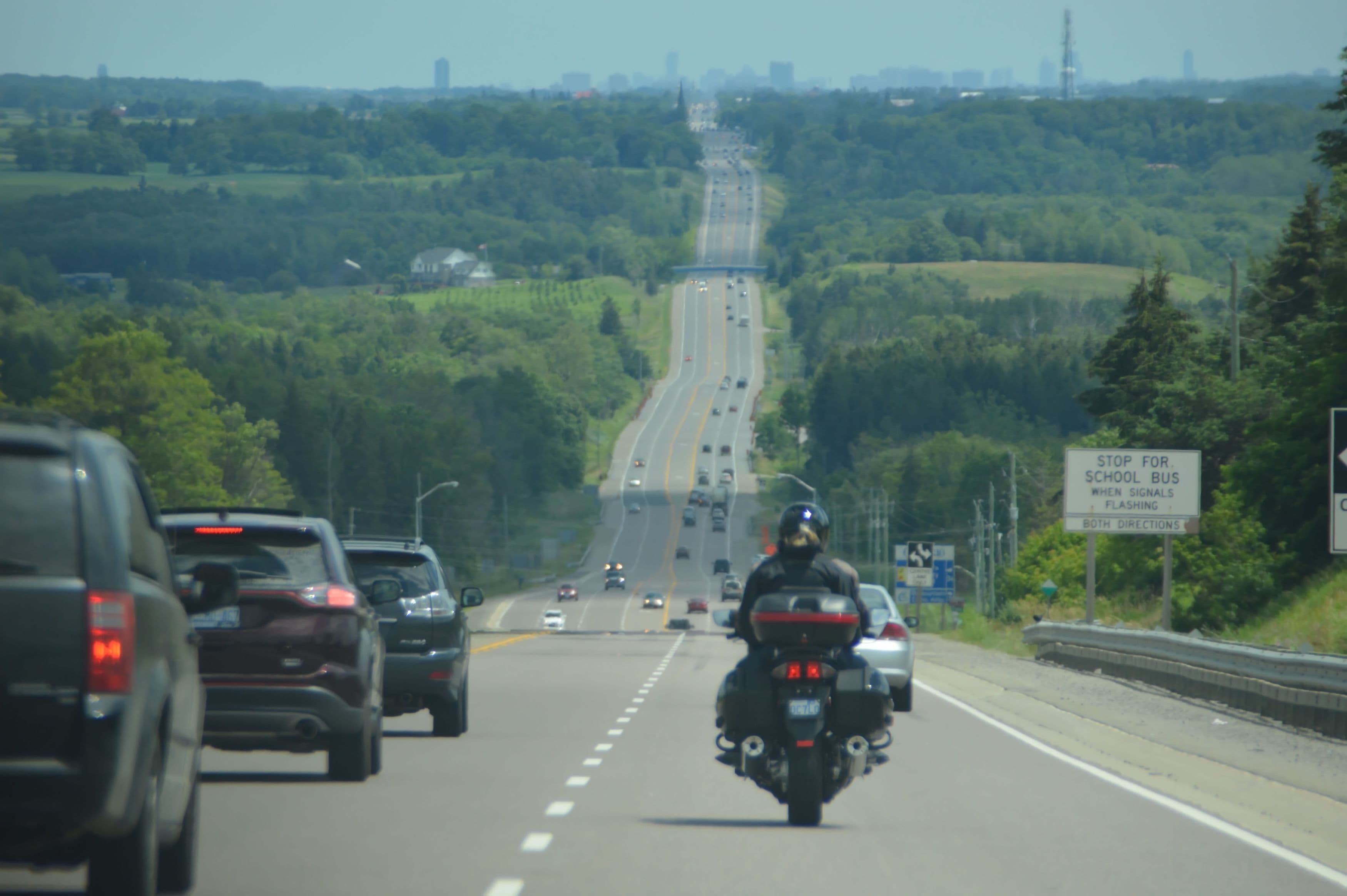
Oregon’s roadways should offer safe passage to motorists of all kinds—including motorcyclists. Due to their smaller size compared to other highway vehicles, motorcycles can be put at greater risk of accident and injury. The threat of being rear-ended by another vehicle, while always a threat to safety, can be far more dangerous for motorcyclists, whose vehicles are both more lightweight and less insulated. The practice of lane splitting (and the practice of lane filtering) is a tactic some riders endorse as a safety measure. But just what is lane splitting, and is it even legal in Oregon? Plus, how does lane splitting differ from lane filtering?
In this blog, we’ll dive into these questions and more, to help endorse safety for all motorists on Oregon’s roadways.
Lane splitting is a method some motorcyclists may use to navigate around slower moving traffic by passing in between lanes. Most standard size motor vehicles need to wait for an opening and change lanes to pass a moving vehicle. However, thanks to their smaller size, it is often possible for motorcycles to pass between two moving vehicles in adjacent lanes.
No. As of now, lane splitting is NOT legal in the state of Oregon. Though some riders may believe it to be a safe practice, the law does not currently recognize this as a legal way to pass another vehicle on a motorcycle.
ORS 214.240 recognizes the operation of a motorcycle “between lanes of traffic or between adjacent lines or rows of vehicles” as a Class B traffic violation. That means it could result in a fine ranging from $135 to $1,000.
Lane filtering is a method of passing between vehicles, much like lane splitting. However, what distinguishes lane filtering is that it only occurs between nonmoving or slow-moving vehicles—most definitions recognize the behavior as lane filtering when the vehicles being passed are traveling at or under 10 miles per hour.
Not everyone makes a distinction between lane splitting and lane filtering, but for many motorcyclists they are thought of as two distinct practices, and many states recognize one as a legal practice while banning the other.
No. Oregon’s current legislature doesn’t make any exception for lane filtering, as opposed to lane splitting. If we refer back to ORS 214.240, we can see that the violation includes any operation of a motorcycle between adjacent lanes or rows of vehicles. That means that it is also considered a Class B traffic violation, subject to the same punitive measures.
In 2025, House Bill 3542 was introduced to the Oregon legislative assembly, setting out to amend ORS 214.240 to allow lane filtering under certain restrictions. These restrictions included the following requirements:
As of the publication of this blog, neither this bill, nor any other attempts to legalize any lane splitting practices, have been passed into law in Oregon. However, House Bill 3542 indicates that at least some lawmakers are still interested in pursuing this type of legislation. That being the case, it is possible that the legality of lane filtering in Oregon could change sometime in the future.
Yes. Oregon law does permit two motorcycles to ride alongside each other in one lane. However, it is not generally recommended, as motorcyclists are generally encouraged to make full use of the lane, changing position as necessary to ensure surrounding drivers can see them.
Neither lane splitting nor lane filtering are permitted in Oregon. However, drivers are always expected to be aware of their surroundings and minimize the risk of accident, and that includes motorcyclists—even when they are engaging in improper driving behaviors.
Note that while the relative safety of lane splitting is still debated, in many cases, a motorcyclist attempting this maneuver might not intend to be rude, but believe it to be a necessary measure for their safety. Though the law does not currently validate lane splitting in Oregon, if you see a motorcycle approaching between lanes, it is still your responsibility to avoid causing a collision. Failing to use proper caution could not only cause unnecessary harm but leave you partially or fully responsible in the eyes of the law.
When a motorcycle accident involves lane splitting or filtering, it can lead to a complex legal situation. When a party violates a law meant to protect motorists, and that violation causes a motor vehicle accident, they may be considered negligent per se.
Negligence per se refers to a situation in which a party can be automatically found negligent, without having to take the usual steps required under tort law to establish negligence. What this means is that a motorcyclist who gets in an accident while lane splitting might be considered negligent per se, since lane splitting is illegal in Oregon.
However, this doesn’t mean that a motorcyclist will always be the at-fault party in an accident involving lane splitting, or that they will always be held financially responsible for other involved parties’ compensation. This is primarily due to two reasons:
Though lane splitting is illegal in Oregon, this does not mean that a motorcycle accident involving lane splitting is an open-and-shut case. A lawyer can help sort through the confusion and maximize the amount available to you. If you believe you are eligible for compensation after a crash, contact an Oregon motorcycle accident lawyer as soon as possible for a free consultation and get the legal guidance you need to move forward.